

What Is Microdosing, and Why Are People Trying It? What Research Says and What to Know
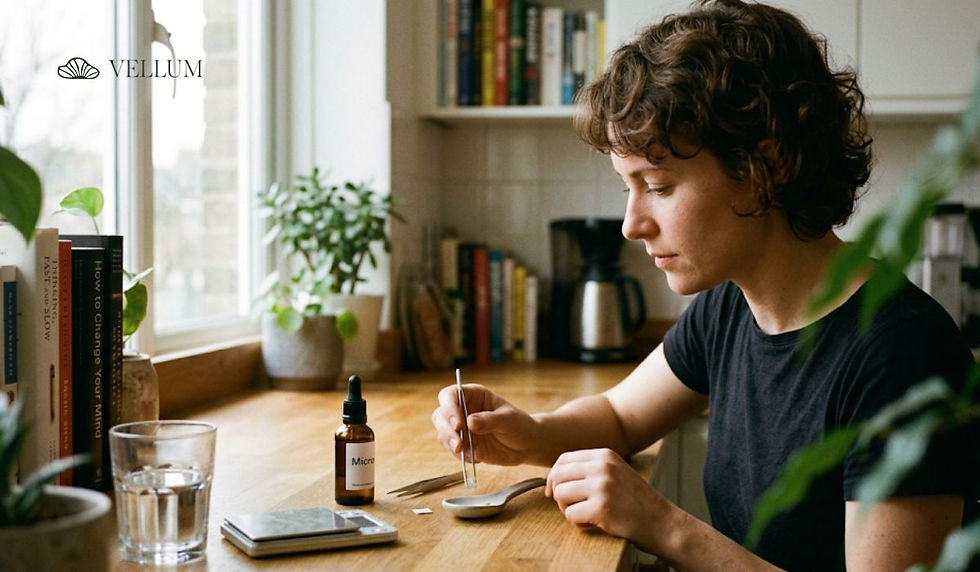
Interest in psychedelics has grown steadily over the past few years, as more and more people experiment with tiny, sub-perceptual amounts of certain substances as part of their daily or weekly routines, instead of taking one full psychoactive dose. This emerging practice, widely known as microdosing, sits at the intersection of curiosity, self-experimentation, and early science, and it raises a fair question worth answering honestly: what is actually happening when someone tries this, and what does the evidence show so far?
What Is Microdosing?
Essentially, a microdose is a fraction of the normal dosage that people use, usually it's about to one-tenth or one-twentieth of a standard quantity. The goal isn't to feel "high" or to experience a noticeable trip. Instead, the amount is kept low enough that most people don't notice strong perceptual changes at all.
This is very different from a recreational or full dose, which is taken specifically to produce a pronounced altered state of consciousness. A small, regular dose is meant to be subtle enough that someone could go about a normal workday without anyone noticing anything unusual.
Possible microdosing of psilocyanin using tiny amounts of psilocybin mushrooms seems to be the type that is most popular. It is this version that the word mostly brings into pictures for other people partly owing to the increasing numbers of anecdotal accounts alongside early research papers about it.
Why Do People Microdose?
People who try this practice usually point to a handful of commonly reported reasons, including:
Focus and concentration — some describe feeling more able to stay on task during work or study.
Mood — others report a subtle lift in day-to-day mood or a sense of emotional balance.
Creativity — a frequently mentioned reason is a feeling of increased openness to new ideas.
Energy — some users say a sense of being more motivated or feeling less mentally tired.
General wellbeing — many simply say they feel more grounded or present.
It is essential that we realize these are the individuals’ subjective feelings, it is in the first place the self-reporting of their own experiences not scientifically proven that you will achieve them. The experiences that one person reports can be totally unknown to another person. As a matter of fact most research on the positive effects of microdosing benefits is based on users' self-reports, not on clinical trials. Therefore results can largely differ from one person to another. These beneficial effect results that have been microdosed reported should be considered as possibilities but not promises.

What Does Microdosing Feel Like?
Because the amounts involved are so small, microdosing effects tend to be subtle by design. Some people notice a mild shift in mood, focus, or energy on the days they take a dose. Others notice very little at all, especially early on or if they're sensitive to placebo-driven expectations.
There's no single, universal experience. Body chemistry, mindset, environment, and even small day-to-day factors can shape how a low dose is experienced on a given day. Recognizing that microdosing effects vary from person to person is part of approaching the practice with realistic expectations, since subtlety is generally the point, not a flaw.
What Does Research Say?
Scientific interest in this space has expanded quickly, but it remains an early and evolving field. Some investigations on microdosing research point to a slight connection between the practice and modest improvements in self-reported mood or mental clarity. But other carefully set up experiments with the inclusion of a placebo have discovered that a lot of the effects reported by participants were not significantly different from what the control group reported which could only be due to their expectations playing the role in their perception.
It's worth separating personal experience from clinical evidence. Anecdotal reports are valuable for understanding how people use this practice in real life, but they aren't the same as controlled research. At this stage, no study has demonstrated that psilocybin microdosing treats or cures any medical condition, and researchers generally agree that larger, longer-term studies are needed before firm conclusions can be drawn. Anyone following microdosing research should treat early findings as a starting point for further reading, not a settled answer.
Potential Risks and Safety
Responses to low doses can vary at a single level, and there are a few reports of people's mild side effects like headaches, appetite fluctuations, sleep disturbances or digestive discomfort as mentioned above. Psilocybin being a hallucinogenic drug could have interactions with certain medications such as antidepressants and it may be risky or unsafe for those suffering from mental health disorder conditions or who have family history of psychosis.
This is where microdosing safety becomes especially relevant. Anyone with existing health conditions, anyone taking prescription medication, or anyone who is pregnant or nursing should speak with a qualified healthcare provider before considering psilocybin microdosing. There are different legal statues around the world, so get familiar with your local laws before continuing further. Professional guidance can account for personal health history in a way that general information never fully can.
Getting Started with Vellum Health
For people who want to explore this practice thoughtfully, Vellum Health offers a range of microdosing products built around quality, consistency, and transparent sourcing. Because detailed dosing information is already covered elsewhere, this section won't repeat it — instead, the Vellum Health dosing guide walks through how to get started, and the product pages outline the available options. Vellum Health prioritizes microdosing safety through clear labeling and consistent formulations, so customers can make informed choices for themselves.
Final Thoughts
Microdosing continues to change, being more of a personal preference, and is far from being a fully comprehended practice. Some people say that they feel very slight changes in emotions, concentration, or energy, on the other hand some don't feel any change. It is obvious that everyone’s experience differs, that scientists are still figuring that out, and that you should not take for granted or take for medically verified anything without solid evidence. Anyone curious about trying it should approach the practice with realistic expectations and consider speaking with a qualified healthcare provider first. Starting with reliable information and honest expectations matters far more than chasing one promised result.
FAQ's
1. What is microdosing?
This basically means taking a very tiny, hardly perceptible amount of the substance, the most commonly used being psilocin, as a substitute rather than a full recreational dose.
2. Why do people microdose?
Mostly shared reasons are about gaining concentration enhancement, mood, creativity, energy, and a better general condition, but they change depending on the person.
3. What are the potential benefits?
The common benefits from using microdoses include, besides better concentrated mind, a steady mood, plus an overall feel of being in good shape. However, as they are not medically verified, they have to be self-reported.
4. What does microdosing feel like?
Microdosing effects are generally minimal. For example, a few people experience minute changes in mood or concentration, whereas others barely feel anything.
5. What does research say?
Results of microdosing studies are a bit all over the place: some studies say that there are small benefits, others claim that the effects are about the same as placebo. There is still room for a deeper exploration and studies with more accurate methods.
6. Is microdosing safe?
That depends on one's past medical history, current medications, and local drug laws to a large extent. It is recommended to consult with a medical practitioner first.


Comments